
How to make a handmade screen-printed wallpaper
Ever wondered how wallpaper is made? Not a machine, industry type of wallpaper, but a wallpaper that is handcrafted with love by an experienced artisan who puts his heart and soul into each piece he creates. I've always been curious about this process, so when the lovely folks from In The Window invited me to experience live the story behind the latest design of award-winning independent wallpaper & textile designer Daniel Heath, I knew it was an opportunity I could not miss. You might wonder who is In The Window and what are they really about.
Well, In The Window is an immersive social experience company, and they have this really cool mission to celebrate only the best & greatest object and space designs.
They enable designers, makers, and even architects to engage on a deep level with each other and with everybody else (meaning the community, meaning you and me). Because once you understand the reason, and the thinking behind a product and how it is made, you see it in a whole new different way (you might even end up loving the product because you know its story). And you know how I am all about concepts and stories!!
So this past Sunday, I got to go to an event called the TOP DRAWER happening at Olympia Exhibition Centre, in London. In The Window was organizing one of their amazing experiences - a workshop where visitors could see and learn live how some things are made, or better yet, how things are crafted by talented designers. This year, the front runner was award-winning independent wallpaper designer Daniel Heath, alongside Jardine Couture (who designed and built a lovely stand) and Pooky, who provided the lighting fixtures for the space.
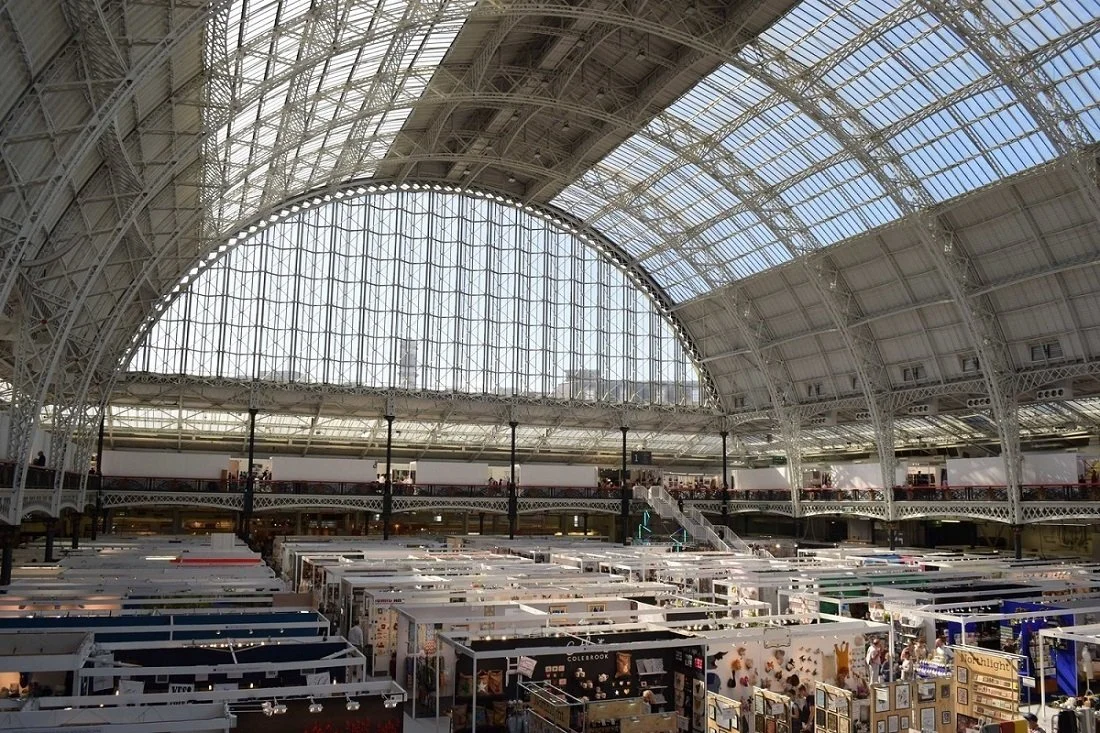
Olympia Design Exhibition Centre London ©Detail Movement


I've seen Daniel's wallpapers before at other design fairs, so I was really excited to learn how he makes his products and what the whole process looks like. Plus, you know how you always see wallpapers that are expensive (for example - around £200-£300) and you wonder why it costs so much? Well, you are about to find out!!
So what is the process?
First things first, you have to have a proper lengthy table or flat surface to work on. It should be smooth and clean so that nothing gets transferred on the back of the paper - Daniel Heath uses 10m of paper for a wallpaper roll, so you need a long table;
Second, you roll out the paper onto the table and make sure it is aligned/parallel to the edge of the table (better measure it first to be on the safe side);
See those black tape spots on the long side of the table? That's the place where a pattern repeat begins or ends. It helps the designer (visually), to make sure that he paints in the right place so that the pattern is correctly positioned and continuous;
Then you get to work.

Handmade wallpaper painting process ©Detail Movement

Handmade wallpaper designer Daniel Heath setting up printing tools ©Detail Movement
After everything is set, it's time to paint using a silk mesh that has the design for the future wallpaper. It's important to mention that each wallpaper design can be made from a single block (that has the whole design), or from two or more blocks. This means that if for example, you want a 2 colour wallpaper design, there will be 2 different mesh blocks that have to be used, one for each colour.
This is one of the reasons why handmade wallpaper costs more than what we normally see in shops. Imagine that you have to create the design, and then create the mesh block. That costs time, energy and money.
What makes this mesh screen so special? By having the screen perforated in different places, the paint only goes where it's supposed to through these tiny holes. This way, you control where the paint ends up on the paper. So after everything is in position and the paint is added onto the mesh - it's sqeegy time!! I think that's what it's called, I don't really know for sure. All I know is that it's a tool with a rubber end to it, so it's like brushing the paint with a big ruler. As you can see below.
JOIN OUR NEWSLETTER
Loving this article so far? Don’t want to miss goodies like this, discounts, and more? Then join our “Thoughtful Edit” interior newsletter. A newsletter unlike any other where the content is shaped by the community to serve the community.

After the whole 10m roll of paper is done, it's time to let dry out. Meanwhile, you can wash the excess or remaining paint off the mesh block. When the paper is dry, then you can start to apply the next layer of the design or the second colour.
So just to recap, the design is being made one colour at a time! Paint - wait for it to dry - paint - wait for it to dry.
While we were in the waiting stage of the process, Daniel unrolled the finished version of his latest design (which he was also creating before our very eyes), called the LEXINGTON which was so beautiful. It was time for some questions, so I took the opportunity to find out:
What type of paint does he use? Standard acrylic paints.
What inspired him to do this design? ART DECO Architecture and the Skyscrapers of that era. You can clearly see where those elements come alive in the design. I love it when I get a sneak peek inside the mind of the designer and I get to see and understand the product, and how he/she sees it, even if it's just for a couple of seconds.
Any particular paint colour he likes more than others? He is into metallic paints at the moment.
Does he take custom-coloured wallpaper requests from clients? Yes, he does. He told us that sometimes, clients’ requests actually offer a source of inspiration for his designs.

Lexington handmade wallpaper design from Daniel Heath ©Detail Movement
Before we got to the second layer, Daniel invited us to try it out for ourselves. Of course, I jumped at the opportunity. I admit that it looks pretty easy when you see an expert at work, so I thought to myself “How hard can this be?” I was so surprised to see that it's actually pretty hard.
First of all - you have to have muscles (which I didn't, obviously). You have to push down and apply pressure so that the paint can squeeze through the mesh and imprint clearly and fully on the paper. Not to mention angle and precision. It's hard work!

Handmade wallpaper making of process ©Detail Movement

Handmade wallpaper making of reveal ©Detail Movement

2 colour handmade wallpaper being made ©Detail Movement

Handmade wallpaper paint details ©Detail Movement

Handmade wallpaper paint how it is made ©Detail Movement
So there you have it detail lovers - how to make a screen-printed wallpaper! The price for a wallpaper like this is between £250 - £350 per 10m roll, depending on how many colours are used. While that might be off-putting at first, if you actually think about it (now that you know the process and effort that is put into it), it seems like a very appropriate price, right? I mean having a space where you can work from, paying to have all the necessities at hand, supplies, doing the design, creating the mesh blocks, all the hours of work perfecting the technique...(imagine making a mistake mid-roll, what do you do then)?
Suddenly, knowing all these things, you really start to appreciate that what you actually buy is a unique, handmade product. I would much rather have something that has passion and effort put into it, instead of something mechanically made. Maybe that's just me, but I think you guys would agree with me on this!
I really enjoyed discovering the story behind Daniel Heath's wallpaper-making process. His designs are quite unique and they pretty much stand out wherever you would put them. Imagine having a feature wall or just a section of a wall covered up with this in any room in your home. Or just a piece of it framed? We were lucky enough to be gifted a piece of the Lexington wallpaper (a full pattern repeat too). I'll definitely get it framed and have it in my workspace area, you know...for inspiration and to remember to try my best in everything I do.
Thank you In The Window and Daniel Heath for the lovely lesson! If you have the passion and you put the hours and work into it, there is no telling where you can end up!
Until next time, Raluca x
*I was invited by In The Window to experience live crafting stories at Top Drawer - a workshop held by wallpaper & textile designer Daniel Heath.*
JOIN OUR NEWSLETTER
Loved this article? Don’t want to miss goodies like this, discounts, and more? Then join our “Thoughtful Edit” interior newsletter. A newsletter unlike any other where the content is shaped by the community to serve the community.

All images that are credited as '©Detail Movement', are done by Raluca Vaduva for Detail Movement. All rights reserved. All pictures that are not my own, I credit them to the best of my knowledge & research, to their offline/online sources. I do not claim ownership over them in any way. If you see your picture on this site and do not wish for it to be displayed, please get in touch and I will remove it or add additional notes at your request.